At 2 A.M., Your Queue Tells the Truth You Can't Say Out Loud
At 2 A.M., Your Queue Tells the Truth You Can't Say Out Loud
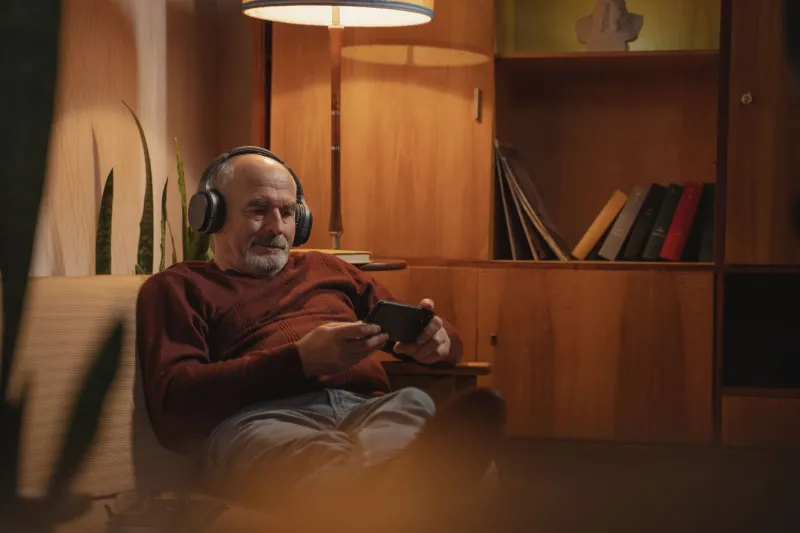
You're not supposed to be awake. You know this. The blue light is bad, the sleep hygiene experts are disappointed, and somewhere in a notebook you swore you'd be in bed by eleven. And yet here you are — phone tilted toward your face in the dark, scrolling past song after song, adding things to a playlist that didn't exist two hours ago and now feels like the most honest document you've ever created.
Nobody assigned this. Nobody's watching. And somehow, that's exactly why it matters.
The Moment the Filter Drops
There's a specific kind of exhaustion that hits after midnight — the kind that doesn't just make you tired, it makes you honest. The social performance of the day has clocked out. You're not managing impressions or choosing the version of yourself that's easiest to explain. You're just you, in the quiet, reaching for something that feels true.
And for a lot of us, what we reach for is music.
Not the playlist you put on during your commute. Not the algorithmic mix your streaming service built based on your most-played tracks from 2019. Something different. Something you're building, in real time, song by song — each addition a small, wordless decision that says: yes, this. this is closer.
Psychologists who study music and emotion talk about something called "mood congruence" — the tendency to seek out music that matches your current emotional state rather than music that contradicts it. But late-night playlist curation goes a step further than that. It's not just matching a mood. It's excavating one. You're not confirming a feeling you've already identified. You're using sound to locate feelings you haven't found language for yet.
That's not passive listening. That's emotional archaeology.
What the Song Selection Actually Reveals
Think about the last time you built one of these late-night queues. Really think about it. What did you put in?
Maybe it started with something obvious — a song you've loved for years that just felt right tonight. But then you added something from a completely different era, a different genre, a different emotional temperature. And then something slower. And then something that you'd honestly forgotten you even knew the words to. And by the time you had fifteen songs in, the playlist had a shape — a kind of emotional arc you didn't consciously design.
That shape is data.
The specific alchemy of what you choose at 2 a.m. — when you're too tired to perform and too awake to sleep — tends to surface the things you've been circling around in daylight without landing on. The song about leaving that you keep adding even though you're not going anywhere. The one about being misunderstood that you'd never admit hits as hard as it does. The track that sounds like a particular summer you don't let yourself think about too directly.
You're not picking songs. You're pointing at things.
Why Music Gets There First
Language is slow. It requires structure, sequence, the right words in the right order. And when you're in the middle of something emotionally complex — grief that isn't clean, longing that doesn't have an obvious object, a restlessness you can't justify — language tends to fail you at exactly the moment you need it most.
Music doesn't have that problem. It bypasses the part of the brain that needs things to make sense and goes straight to the part that just feels. A chord progression can hold contradictions that a sentence can't — the bittersweet, the furious-and-tender, the grieving-and-grateful. It can be two things at once in a way that words rarely manage without sounding like a riddle.
This is why your 2 a.m. queue sometimes knows things your therapist doesn't — not because therapy isn't working, but because the playlist isn't operating in the same medium. Your therapist is working in language. Your playlist is working in something older and less edited. Both are valuable. But only one of them gets built in the dark with no one watching, from pure instinct, with zero obligation to be coherent.
There's a reason artists from Phoebe Bridgers to Frank Ocean to Mitski have built entire careers on the specific frequency of late-night emotional honesty. They're not making music for your commute. They're making music for this — for the version of you that only comes out when the performance is over.
The Playlist as a Mirror You're Not Ready to Look At
Here's the thing nobody really talks about: sometimes you finish building the playlist and you sit with it for a second and something about it makes you uncomfortable. Not in a bad way, exactly. More like the feeling of accidentally catching your own reflection and seeing something real.
Because the songs you chose — taken together, as a collection — often say something you haven't consciously admitted. Maybe the throughline is loneliness. Maybe it's ambition that's curdling into resentment. Maybe it's love for someone specific that you've been pretending is just nostalgia. The playlist doesn't care about your rationalizations. It just holds up what you reached for.
That's uncomfortable. It's also, in a strange way, a relief.
There's something clarifying about having a document of your own subconscious — even an accidental one. Even one made of other people's songs. The music you curate in those unguarded hours is yours in a way that's hard to explain: you didn't write it, but you claimed it. You built a container for a feeling that didn't have a shape yet, and now it has one.
Don't Delete It in the Morning
Here's my actual advice, for whatever it's worth: don't clean it up when daylight hits.
There's a reflex to rationalize the 2 a.m. version of yourself — to look at the playlist in the morning and quietly remove the songs that feel too revealing, too sad, too something. To curate the curated thing until it's presentable. Until it looks like a person who has it together.
Resist that.
Let it exist as the artifact it is. Go back and listen to it a week later, or a month later, and notice what it was trying to tell you. Sometimes you'll recognize it immediately. Sometimes it'll take longer. But the late-night queue is rarely lying — it's just speaking in a language that takes a little time to translate.
The storm that keeps you up at 2 a.m. isn't random noise. It's signal. And somewhere in the middle of that playlist you built from instinct and exhaustion and whatever you couldn't say out loud — there's a clarity that daylight tends to drown out.
Your queue is trying to tell you something. It might be worth listening.